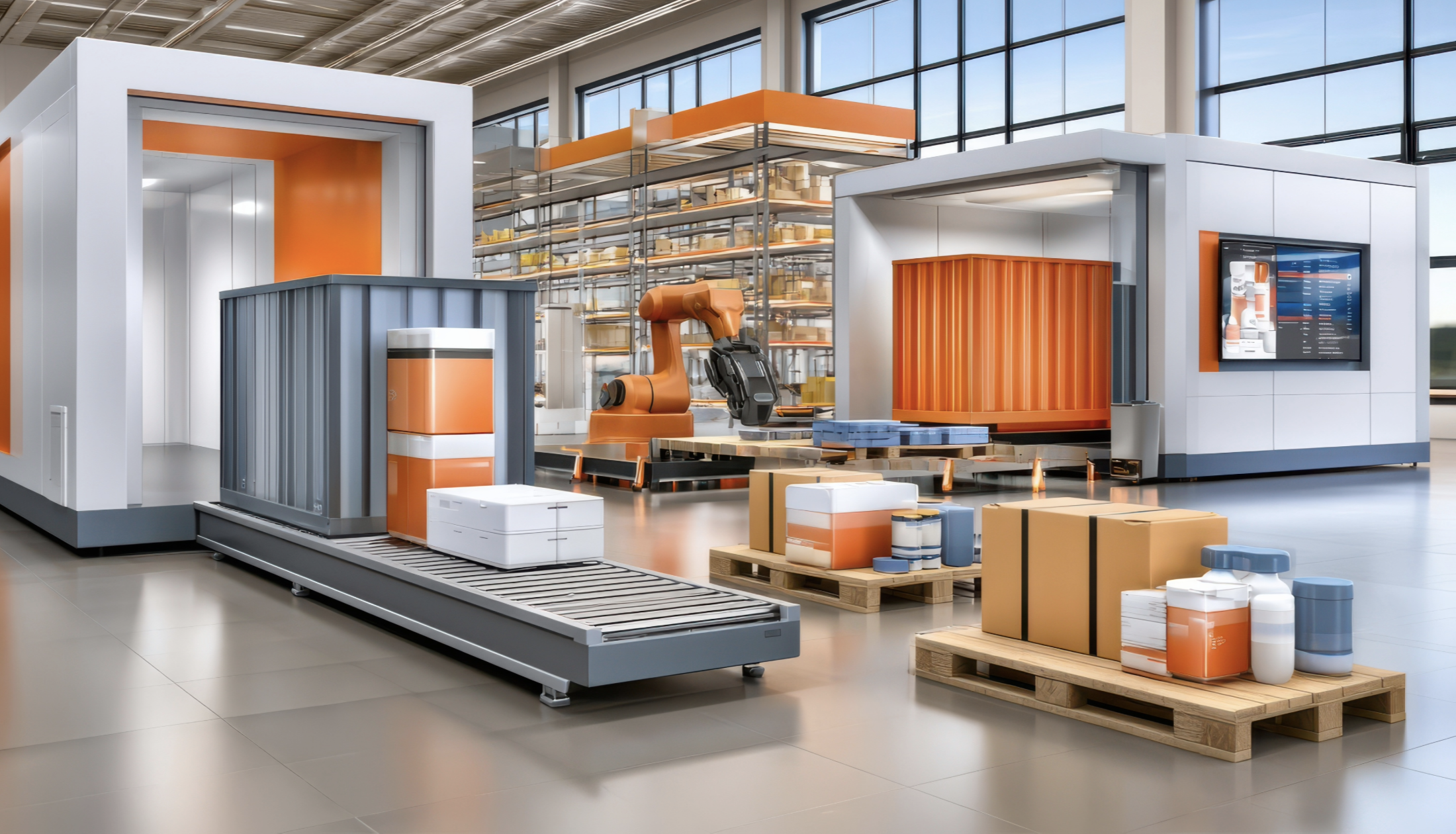
What Is a Temperature-Controlled Warehouse?
A temperature-controlled warehouse is a specialized storage facility designed to maintain products within a defined temperature range throughout the storage period.
Unlike conventional warehouses, where ambient conditions may be sufficient for many products, temperature-controlled facilities use refrigeration, cooling, heating, insulation, monitoring, and other systems to maintain the environmental conditions required by temperature-sensitive products.
These facilities are commonly used for products such as:
- Pharmaceuticals and healthcare products
- Vaccines and certain medical products
- Food and beverages
- Dairy products
- Frozen foods
- Meat and seafood
- Fruits and vegetables
- Certain cosmetics and personal care products
- Chemicals
- Nutraceuticals
- Other temperature-sensitive materials
Temperature-controlled warehousing is particularly important when exposure to unsuitable temperatures can affect product quality, shelf life, safety, efficacy, or compliance.
WareIQ’s reference describes temperature-controlled warehouses as specialized facilities designed to maintain precise temperature and humidity conditions and highlights their use across industries including food, pharmaceuticals, nutraceuticals, beauty, and cosmetics.
Temperature-Controlled Warehouse vs Cold Storage
The terms temperature-controlled warehouse and cold storage warehouse are sometimes used interchangeably, but they can describe different ranges of requirements.
A cold storage warehouse generally refers to a facility designed for products that need refrigerated or frozen conditions.
A temperature-controlled warehouse is a broader category that can include facilities maintained at different temperature ranges, including chilled, refrigerated, frozen, or controlled ambient conditions.
For example, a product may need:
- Controlled ambient storage
- Chilled storage
- Refrigerated storage
- Frozen storage
- Deep-frozen storage
The correct facility depends on the product’s specifications rather than simply whether the product is classified as “perishable.”
Types of Temperature-Controlled Warehouses
Temperature-controlled warehouses can be classified based on the temperature range and products being stored.
| Type | Typical Requirement | Common Applications |
| Controlled ambient | Stable temperature within a specified range | Pharmaceuticals, cosmetics, specialty products |
| Chilled storage | Low but non-frozen temperature | Dairy, beverages, fresh food |
| Refrigerated storage | Refrigerated conditions | Food, pharma, healthcare |
| Frozen storage | Below-freezing conditions | Frozen food, meat, seafood |
| Deep-freeze storage | Very low temperatures | Certain pharmaceuticals and specialized products |
| Multi-temperature facility | Multiple controlled zones | Food, pharma, diversified product portfolios |
The exact temperature range should always be determined from the product’s storage specifications, regulatory requirements, manufacturer instructions, and applicable quality standards.
Why Do Businesses Need Temperature-Controlled Warehousing?
Temperature can directly affect the physical and chemical characteristics of many products.
For example, excessive heat can accelerate spoilage or degradation, while freezing can damage products that are not designed to withstand low temperatures.
A temperature-controlled warehouse helps businesses maintain suitable storage conditions between production or procurement and the next stage of distribution.
Protect Product Quality
Maintaining the required temperature can help preserve product quality and reduce the risk of deterioration.
Extend Shelf Life
For appropriate products, maintaining recommended environmental conditions can help preserve shelf life and reduce avoidable wastage.
Reduce Product Loss
Temperature excursions can damage inventory. Continuous monitoring and appropriate facility design can reduce the risk of undetected temperature problems.
Support Regulatory Requirements
Certain industries have strict requirements concerning the storage and handling of temperature-sensitive products.
Businesses therefore need facilities and processes capable of supporting the applicable standards and documentation requirements.
Support Distribution
Temperature-controlled warehouses act as important nodes within a broader cold-chain or controlled-temperature supply chain.
The warehouse must work together with temperature-controlled transportation and handling processes where required.
How Does a Temperature-Controlled Warehouse Work?
The basic principle is maintaining a stable environmental condition inside a controlled storage area.
A typical operation involves several components.
1. Insulated Structure
Temperature-controlled areas require suitable insulation to reduce heat transfer between the internal environment and external conditions.
Walls, ceilings, doors, floors, and other structural elements can influence thermal performance.
2. Refrigeration or HVAC Systems
Cooling, heating, or HVAC systems maintain the required temperature.
The equipment needs to be appropriately sized for the facility, product load, ambient conditions, door openings, and operational requirements.
3. Temperature Monitoring
Sensors are placed at relevant points within the facility to monitor temperature conditions.
Modern systems can provide continuous monitoring and alerts when conditions move outside predefined limits.
4. Controlled Access
Frequent opening of temperature-controlled doors can affect internal conditions.
Facilities therefore need processes that control access and minimize unnecessary temperature fluctuations.
5. Backup Systems
Temperature-sensitive inventory can be particularly vulnerable during equipment failure or power interruptions.
Depending on the business requirement, backup power, redundant refrigeration systems, emergency procedures, and escalation protocols may be necessary.
Infrastructure Requirements for a Temperature-Controlled Warehouse
A temperature-controlled warehouse requires more than refrigeration equipment.
Insulation
Proper insulation reduces heat transfer and helps refrigeration systems maintain the desired conditions efficiently.
Refrigeration Equipment
The cooling system should be appropriate for the required temperature range and warehouse size.
Temperature Sensors
Sensors should be positioned appropriately to provide meaningful monitoring across the storage environment.
Backup Power
Power interruptions can create risks for temperature-sensitive inventory.
Backup generators, UPS systems, or other appropriate power-continuity measures may be required depending on the facility and product.
Temperature-Controlled Doors
Doors can become a major source of temperature fluctuation.
High-frequency operations may require appropriately designed doors, loading systems, and operating procedures.
Loading and Unloading Areas
The movement of products between transportation vehicles and controlled storage areas needs to minimize exposure to unsuitable environmental conditions.
Racking Systems
Storage racking needs to be compatible with the facility, product dimensions, handling equipment, and temperature-controlled environment.
Fire and Safety Systems
Safety infrastructure needs to be appropriate for the facility and its stored products.
Monitoring and Alerts
Automated monitoring can help operations teams identify temperature deviations before they become larger inventory problems.
Temperature-Controlled Warehouse Technology
Technology plays an important role in managing temperature-sensitive inventory.
Warehouse Management System
A WMS can track inventory locations, stock movements, receiving, picking, dispatch, and other warehouse activities.
Temperature Monitoring Systems
Sensors can continuously record temperature data and trigger alerts when conditions move outside defined thresholds.
Data Logging
Temperature data can be recorded to support operational analysis, quality processes, and applicable compliance requirements.
Automated Alerts
If a temperature excursion occurs, alerts can notify responsible personnel so that corrective action can begin quickly.
ERP and WMS Integration
Integrating warehouse systems with ERP and other business applications can provide better visibility into inventory and operational activity.
Real-Time Dashboards
Dashboards can combine inventory and environmental data to give teams a clearer view of warehouse performance.
Goldfishh’s warehouse technology consulting service focuses on ERP systems such as SAP, Microsoft Dynamics, NetSuite, and Zoho, along with WMS and TMS integration and technology-driven warehouse transformation.
Industries That Use Temperature-Controlled Warehouses
1. Pharmaceutical Industry
Pharmaceutical products can have specific storage requirements that need to be maintained throughout warehousing and distribution.
Temperature monitoring, documentation, handling processes, and compliance become particularly important.
2. Food and Beverage
Dairy, meat, seafood, frozen foods, beverages, and other perishable products may require controlled storage conditions.
Cold-chain infrastructure helps maintain product quality between production and distribution.
3. Nutraceuticals
Some supplements and nutraceutical products may require controlled environmental conditions to maintain their quality and shelf life.
4. Cosmetics and Personal Care
Certain formulations and ingredients can be sensitive to temperature and environmental conditions.
Temperature-controlled storage can therefore be relevant for selected beauty and personal-care products.
5. Chemicals
Some chemicals require controlled storage because temperature can affect their stability, safety, or physical properties.
The exact storage environment depends on the material and applicable safety requirements.
6. Agriculture and Fresh Produce
Fruits, vegetables, and other agricultural products may require controlled temperatures to slow deterioration and preserve freshness during distribution.
Temperature-Controlled Warehouse vs Conventional Warehouse
| Factor | Conventional Warehouse | Temperature-Controlled Warehouse |
| Temperature | Generally ambient | Controlled within defined limits |
| Refrigeration | Usually not required | May be required |
| Insulation | Standard requirements | Specialized insulation often required |
| Monitoring | Basic environmental monitoring | Continuous temperature monitoring may be required |
| Energy consumption | Generally lower | Generally higher |
| Infrastructure cost | Lower in many cases | Higher due to specialized systems |
| Maintenance | Standard | Refrigeration/HVAC maintenance required |
| Suitable products | General merchandise | Temperature-sensitive products |
| Backup requirements | Standard | May require additional contingency measures |
Temperature-controlled warehousing therefore usually involves higher infrastructure and operating requirements than conventional storage.
What Are the Challenges of Temperature-Controlled Warehousing?
High Operating Costs
Refrigeration, electricity, maintenance, specialized equipment, monitoring, and trained personnel can increase operating costs.
Energy Consumption
Maintaining a controlled environment requires continuous energy use, particularly in refrigerated and frozen facilities.
Temperature Excursions
A failure in refrigeration, power, monitoring, or operating procedures can cause the warehouse temperature to move outside the required range.
Equipment Maintenance
Cooling and refrigeration systems require preventive maintenance to reduce the risk of unexpected failures.
Product-Specific Requirements
Different products may have different temperature requirements.
A warehouse that works for chilled food may not necessarily be appropriate for frozen products or temperature-sensitive pharmaceuticals.
Loading and Unloading
Every movement between transportation and storage creates a potential exposure point.
Processes need to minimize the time products spend outside their required environmental conditions.
Space Utilization
Temperature-controlled space is expensive, making effective warehouse layout and storage utilization particularly important.
How to Choose a Temperature-Controlled Warehouse
Businesses should evaluate a facility based on their actual product requirements rather than simply selecting the warehouse with the lowest storage rate.
1. Determine the Required Temperature Range
Start with the product’s storage specification.
Determine whether the product needs controlled ambient, chilled, refrigerated, frozen, or another specialized environment.
2. Evaluate Geographic Location
Warehouse location affects transportation costs, delivery times, access to markets, and the overall cold-chain network.
3. Check Temperature Monitoring
Understand how temperatures are monitored, recorded, and reported.
Ask about sensor coverage, alert systems, data retention, and escalation procedures.
4. Review Backup Systems
Understand the facility’s contingency arrangements for power failures, refrigeration equipment failures, and other emergencies.
5. Evaluate Warehouse Infrastructure
Assess insulation, refrigeration equipment, loading areas, doors, racking, material-handling equipment, and maintenance procedures.
6. Check Product Handling Capabilities
The facility should be able to handle the product safely during receiving, storage, picking, and dispatch.
7. Assess Technology
Evaluate WMS, inventory visibility, barcode systems, monitoring systems, reporting, and integration capabilities.
8. Consider Scalability
Businesses should consider whether the facility can support future increases in inventory and distribution requirements.
How Much Does Temperature-Controlled Warehousing Cost?
There is no universal temperature-controlled warehouse price.
Costs depend on factors such as:
| Cost Factor | Why It Matters |
| Temperature range | Lower temperatures can require more energy and specialized equipment |
| Storage volume | Determines required warehouse capacity |
| Location | Warehouse and logistics costs vary by geography |
| Product type | Handling requirements can vary significantly |
| Storage duration | Longer storage increases total cost |
| Energy costs | Refrigeration can significantly affect operating expenses |
| Handling | Receiving, picking, packing, and dispatch add operational costs |
| Technology | Monitoring and WMS capabilities may affect pricing |
| Compliance | Specialized requirements can increase infrastructure and operational costs |
| Transportation | Temperature-controlled inbound and outbound logistics can add cost |
Businesses should therefore evaluate total cold-chain cost, rather than comparing warehouse rent alone.
How to Improve Temperature-Controlled Warehouse Efficiency
Optimize Storage Layout
Efficient racking and warehouse layouts can increase usable capacity while maintaining appropriate product handling and movement paths.
Monitor Temperature Continuously
Continuous monitoring can provide earlier visibility into temperature deviations than periodic manual checks.
Maintain Refrigeration Equipment
Preventive maintenance can help reduce unexpected equipment failures and operational disruptions.
Reduce Unnecessary Door Openings
Operational processes should minimize unnecessary opening of temperature-controlled areas.
Improve Inventory Rotation
Products should be managed according to their shelf life, demand, and storage requirements.
Use Warehouse Technology
Integrating WMS, inventory management, temperature monitoring, and reporting systems can improve operational visibility.
Audit Warehouse Operations
Regular warehouse audits can identify inefficiencies in layout, inventory, equipment, processes, and operational controls.
Temperature-Controlled Warehousing and Supply Chain Network Design
Temperature-controlled storage should not be evaluated in isolation.
A company distributing temperature-sensitive products across India may need to determine:
- Where temperature-controlled warehouses should be located
- How many facilities are required
- Which products should be stored at each location
- How inventory should be distributed
- How transportation should connect facilities
- Whether shared or dedicated facilities are appropriate
- How much capacity is needed in each region
Supply chain network design can help businesses evaluate these questions.
This becomes particularly important when transportation distances are long or when the business is expanding into new markets.
Goldfishh provides supply chain network design and audit capabilities alongside its warehouse services, allowing warehouse requirements to be considered as part of the broader distribution network rather than as an isolated storage decision.
When Should a Business Use a 3PL for Temperature-Controlled Warehousing?
Building and operating a temperature-controlled facility requires significant infrastructure, technical expertise, maintenance, energy management, and operational processes.
A 3PL can be worth considering when a business:
- Needs temperature-controlled storage but does not want to build its own facility
- Is entering a new geographic market
- Has seasonal storage requirements
- Needs additional capacity
- Wants to reduce infrastructure investment
- Requires specialized warehouse expertise
- Needs integrated warehousing and distribution
- Wants to scale without committing to a large dedicated facility
A 3PL partner can potentially manage warehouse selection, infrastructure, staffing, inventory operations, technology, and daily warehouse management.
Goldfishh’s 3PL warehouse operations service covers warehouse selection, infrastructure setup, automation, security and compliance, software implementation, staffing, daily operations, and performance management.
How Goldfishh Supports Temperature-Controlled Warehousing
For businesses looking for temperature-controlled warehouse capacity, Goldfishh WAREOSPACE is the most relevant product from the options provided.
Goldfishh’s WAREOSPACE network includes specialized temperature-controlled warehouses with stated temperature ranges from -18°C to 25°C, along with cold-chain facilities. The network also includes general, compliant, bonded, chemical and FTZ warehouse options.
The managed warehouse model is designed around shared, pay-per-use infrastructure, allowing businesses to access warehouse capacity without necessarily making the same level of upfront infrastructure investment associated with developing their own facility. Goldfishh also describes WAREOSPACE as supporting omni-channel distribution, freight, logistics, and ecommerce fulfillment.
This can be relevant for businesses in industries such as food and beverages, pharmaceuticals, healthcare, beauty and cosmetics, and other sectors where controlled storage conditions are part of the supply chain requirement. Goldfishh’s WAREOSPACE materials specifically list packaged food and beverages, cold-chain and temperature-controlled operations, healthcare and pharmaceuticals, and beauty and cosmetics among its industry categories.
For businesses with more complex requirements, Goldfishh also offers 3PL warehouse operations management, including warehouse selection, infrastructure, automation, staffing, technology, compliance, and performance management.
Other services can support the broader project, including warehouse racking and layout design, warehouse audits, supply chain network design, supply chain network audits, warehouse technology consulting, and built-to-suit warehouse development.
FAQs About Temperature-Controlled Warehouses
What is a temperature-controlled warehouse?
A temperature-controlled warehouse is a facility designed to maintain products within a defined temperature range using systems such as refrigeration, HVAC, insulation, monitoring, and controlled operating processes.
What products require temperature-controlled storage?
Common examples include pharmaceuticals, healthcare products, vaccines, dairy, frozen foods, meat, seafood, certain beverages, nutraceuticals, cosmetics, chemicals, and other temperature-sensitive products.
What is the difference between a cold storage warehouse and a temperature-controlled warehouse?
Cold storage generally refers to refrigerated or frozen storage, while temperature-controlled warehousing is a broader category that can include controlled ambient, chilled, refrigerated, frozen, and other defined temperature environments.
What temperature range is used in a temperature-controlled warehouse?
There is no single temperature range. The required range depends on the product. Goldfishh’s WAREOSPACE offering states that its temperature-controlled warehouse network supports ranges from -18°C to 25°C.
Why is temperature monitoring important?
Temperature monitoring helps businesses identify deviations from required storage conditions and take corrective action when necessary. Continuous monitoring can provide better visibility than occasional manual checks.
Are temperature-controlled warehouses more expensive?
They generally involve additional infrastructure and operating requirements compared with conventional warehouses because of refrigeration, insulation, energy consumption, monitoring, and maintenance. Actual costs vary by temperature range, location, volume, product type, and services required.
Can a 3PL provide temperature-controlled warehousing?
Yes. Depending on the provider, a 3PL can provide temperature-controlled storage along with receiving, inventory management, picking, packing, distribution, technology, and other warehouse operations.
How should a business choose a temperature-controlled warehouse?
Businesses should evaluate the required temperature range, facility location, monitoring systems, backup infrastructure, refrigeration equipment, product handling processes, technology, compliance requirements, capacity, scalability, and total logistics cost.
Conclusion
A temperature-controlled warehouse is an important part of the supply chain for products that cannot be safely or effectively stored under normal ambient conditions.
The right facility needs to provide more than refrigeration. Insulation, temperature monitoring, backup systems, warehouse layout, inventory management, technology, maintenance, handling processes, and transportation all contribute to maintaining product integrity.
Businesses should therefore evaluate temperature-controlled warehousing as part of the wider supply chain rather than treating it as simply a specialized storage requirement.
For companies that need flexible access to temperature-controlled and cold-chain warehouse capacity, Goldfishh WAREOSPACE provides a relevant managed warehouse option, with stated temperature-controlled facilities ranging from -18°C to 25°C. For larger or more complex requirements, 3PL operations, warehouse audits, network design, warehouse technology consulting, racking, and built-to-suit solutions can be evaluated as part of a broader warehousing strategy.