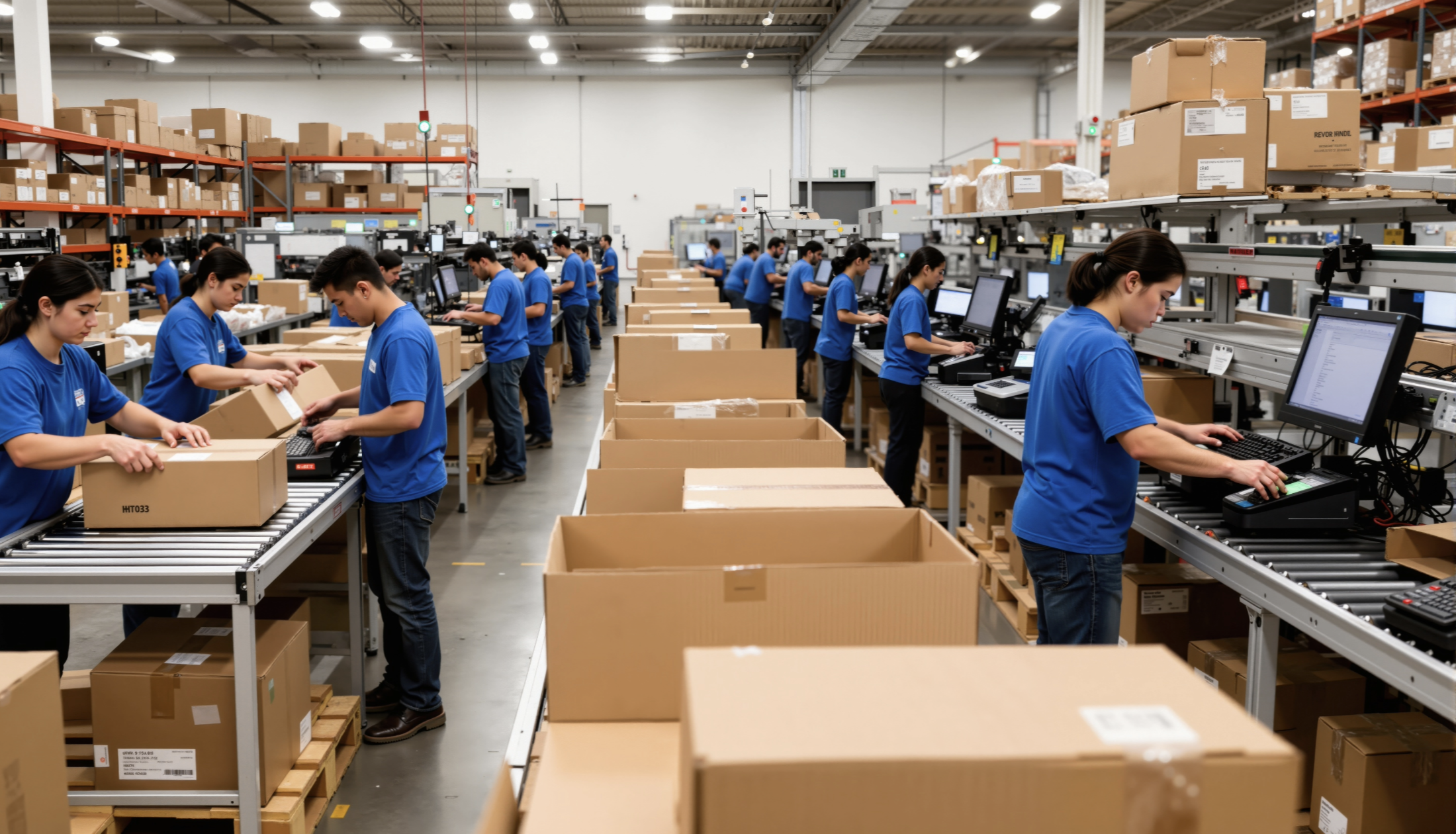
What Is Pick and Pack Fulfillment?
Pick and pack fulfillment is the warehouse process of selecting products from inventory and packing them for shipment after a customer places an order.
It is one of the most important stages of the e-commerce fulfillment process because it directly affects order accuracy, processing time, packaging costs, inventory accuracy, and ultimately the customer experience.
The basic process is simple:
Customer places an order → Order is received → Products are picked → Products are checked → Order is packed → Shipment is labeled → Order is dispatched
Although the concept is straightforward, managing pick and pack operations efficiently becomes more difficult as order volumes, SKUs, sales channels, and warehouse locations increase.
A professional fulfillment operation therefore combines warehouse layout, inventory management, picking methods, packing processes, technology, quality checks, and shipping operations.
How Does Pick and Pack Fulfillment Work?
A typical pick and pack process involves several steps.
1. Order Is Received
The process starts when an order is placed through an e-commerce website, marketplace, mobile application, or another sales channel.
The order information is transmitted to the warehouse or fulfillment system.
2. Order Is Processed
The fulfillment system checks the order details, inventory availability, SKU information, quantity, shipping address, and other relevant information.
If the warehouse uses a WMS, the system can generate or prioritize picking tasks based on warehouse rules.
3. Products Are Picked
Warehouse employees or automated systems locate the required products and retrieve them from their storage locations.
The picking method depends on order volume, SKU count, warehouse layout, product characteristics, and order patterns.
4. Products Are Verified
Picked products may be scanned or manually checked against the order.
This step helps identify incorrect SKUs, quantities, or damaged products before the order is packed.
5. Products Are Packed
The products are placed into suitable packaging based on their size, weight, fragility, and shipping requirements.
Packaging may include boxes, mailers, protective material, inserts, labels, or branded packaging.
6. Shipping Label Is Created
The shipment is assigned the required shipping information, including the destination address, order details, tracking information, and carrier information.
7. Order Is Dispatched
The completed package is moved to the dispatch area and handed over to the relevant transportation or delivery partner.
Pick and Pack Fulfillment Process
| Stage | Warehouse Activity | Main Objective |
| Order receipt | Receive customer order | Start fulfillment |
| Inventory check | Confirm SKU availability | Avoid fulfillment delays |
| Picking | Retrieve products | Select correct items |
| Verification | Scan/check items | Improve order accuracy |
| Packing | Package products | Protect products |
| Labeling | Generate shipping label | Prepare shipment |
| Sorting | Organize shipments | Improve dispatch efficiency |
| Dispatch | Hand over to carrier | Move order to customer |
The efficiency of each stage affects the overall fulfillment cycle time.
Types of Picking Methods in Pick and Pack Fulfillment
There is no single picking method suitable for every warehouse.
Piece Picking
A worker picks products for one order at a time.
This is relatively straightforward and can work well for businesses with lower order volumes.
Best suited for: smaller operations and low-volume orders.
Batch Picking
A worker picks products for multiple orders during the same warehouse trip.
For example, if several orders contain the same SKU, the picker can collect those units together.
Best suited for: high-volume operations with repetitive SKUs.
Zone Picking
The warehouse is divided into different zones, with workers assigned to specific areas.
Orders move between zones as different products are picked.
Best suited for: large warehouses with many SKUs.
Wave Picking
Orders are grouped into picking waves based on factors such as carrier cutoff time, destination, order priority, or product category.
Best suited for: larger fulfillment operations with structured dispatch schedules.
Automated Picking
Automation such as conveyors, automated storage systems, scanners, and robotics can assist with product movement and picking.
Best suited for: high-volume operations where automation can justify its investment.
Pick and Pack vs Pick, Pack and Ship
These terms are closely related but do not describe exactly the same activity.
Pick and pack fulfillment focuses on retrieving products and preparing orders for dispatch.
Pick, pack and ship fulfillment includes the transportation stage as well, meaning the fulfillment provider manages the order through dispatch and shipping.
For many e-commerce businesses, these activities are integrated into one fulfillment operation.
Benefits of Pick and Pack Fulfillment
1. Faster Order Processing
A structured picking and packing operation reduces unnecessary movement and manual processing.
This can help warehouses process more orders within the same operating period.
2. Better Order Accuracy
Scanning, barcode verification, standardized workflows, and quality checks can reduce incorrect product or quantity issues.
3. Lower Fulfillment Costs
An optimized warehouse layout and picking strategy can reduce unnecessary labor and movement.
However, cost savings depend on order volume, product mix, warehouse design, technology, and operating model.
4. Better Inventory Control
Pick and pack operations are closely connected to inventory accuracy.
Every product movement should be recorded so that available inventory reflects actual warehouse stock.
5. Scalability
Businesses can use structured fulfillment operations to handle increasing order volumes without redesigning the entire process every time demand grows.
6. Better Customer Experience
Faster and more accurate fulfillment can reduce shipment delays and incorrect orders.
Packaging quality also contributes to the customer’s overall experience.
What Factors Affect Pick and Pack Fulfillment Costs?
Pick and pack fulfillment pricing varies significantly between providers and business models.
Common cost components include:
| Cost Component | What It Covers |
| Storage | Space used to hold inventory |
| Receiving | Unloading and processing inbound stock |
| Picking | Labor or technology used to retrieve products |
| Packing | Packaging labor and materials |
| Shipping | Transportation to the customer |
| Kitting | Combining multiple products into one order |
| Returns | Processing returned products |
| Technology | WMS, integrations, reporting, and automation |
| Special handling | Fragile, oversized, regulated, or temperature-sensitive products |
Some providers charge a fixed fulfillment fee per order, while others separate storage, picking, packing, shipping, and additional services.
Businesses should therefore compare the total fulfillment cost per order, rather than looking only at the advertised pick-and-pack fee.
What Determines the Cost Per Order?
Several factors can influence the final cost.
Order Volume
Higher order volumes can improve warehouse labor utilization and may change the commercial structure offered by a fulfillment provider.
Number of SKUs
A warehouse handling hundreds of SKUs has different picking requirements from one handling thousands or tens of thousands.
Number of Items Per Order
An order containing one item is operationally different from an order containing ten different SKUs.
Product Size and Weight
Large or heavy products require different storage, handling, packing, and transportation arrangements.
Packaging Requirements
Fragile products, premium packaging, branded boxes, inserts, or specialized materials can increase fulfillment costs.
Geographic Distribution
The location of fulfillment centers affects transportation distance and delivery costs.
Returns
Businesses with high return volumes need additional reverse logistics and inspection processes.
How Technology Improves Pick and Pack Fulfillment
Technology can significantly improve fulfillment operations when it is implemented around actual warehouse requirements.
Warehouse Management System
A WMS can manage inventory locations, picking tasks, stock movements, receiving, dispatch, and warehouse workflows.
Goldfishh states that its WAREOSPACE network can integrate selected warehouses with a WMS to provide a unified view of supply chain and distribution operations.
Barcode Scanning
Barcodes help workers identify products and verify orders during picking and packing.
Order Management Integration
Connecting warehouse systems with e-commerce stores and marketplaces can reduce manual order entry.
Real-Time Inventory Visibility
Businesses can see inventory across warehouse locations and sales channels, helping reduce overselling and stock discrepancies.
Automated Picking and Conveyors
Larger warehouses may use automation to move products between storage, picking, packing, and dispatch areas.
Analytics
Warehouse data can be used to identify slow-moving SKUs, high-volume products, picking bottlenecks, packing errors, and capacity issues.
Common Pick and Pack Fulfillment Challenges
Incorrect Picking
Selecting the wrong SKU or quantity can lead to customer complaints, returns, and additional shipping costs.
Poor Warehouse Layout
If frequently ordered products are stored far from packing or dispatch areas, workers spend more time walking and handling inventory.
Inventory Inaccuracy
A warehouse may show a product as available in the system even though the physical stock is unavailable.
SKU Proliferation
As businesses add more products, finding and managing inventory becomes more complicated.
Packaging Inefficiency
Using oversized packaging can increase material usage and shipping costs, while insufficient packaging can result in product damage.
Order Volume Spikes
Sales events, festive periods, promotions, and product launches can create temporary increases in order volume.
Returns
Returns require additional receiving, inspection, inventory updates, and potential repackaging.
Best Practices for Pick and Pack Fulfillment
1. Optimize Warehouse Layout
Frequently picked products should be positioned where they can be retrieved efficiently.
Warehouse layout should consider product dimensions, order frequency, picking paths, storage capacity, receiving, packing, and dispatch.
Goldfishh’s warehouse racking and design service considers factors such as pallet positions, racking height, aisle widths, product zoning, and space allocation for receiving, staging, and dispatch.
2. Use ABC Inventory Classification
High-demand products should generally receive greater attention when designing storage and picking strategies.
ABC analysis can help identify products that contribute disproportionately to order volume or inventory movement.
3. Use Barcode Verification
Scanning products at important points in the fulfillment process can improve accuracy.
4. Standardize Packing
Define packaging guidelines for different product categories.
This helps reduce inconsistent packaging and unnecessary material consumption.
5. Track Fulfillment KPIs
Important metrics include:
| KPI | What It Measures |
| Order accuracy | Percentage of orders fulfilled correctly |
| Pick accuracy | Accuracy of product selection |
| Pick rate | Orders or units picked per labor hour |
| Order cycle time | Time from order receipt to dispatch |
| On-time dispatch | Orders dispatched within target time |
| Inventory accuracy | Difference between system and physical inventory |
| Cost per order | Total fulfillment cost per order |
| Return rate | Percentage of orders returned |
6. Review Warehouse Performance Regularly
Warehouse audits can identify problems with inventory, layout, processes, capacity, equipment, and operational efficiency before they become larger issues.
7. Plan Capacity Before Peak Seasons
Businesses should forecast expected order volumes and ensure sufficient warehouse labor, storage, packaging materials, and dispatch capacity before major sales periods.
When Should You Outsource Pick and Pack Fulfillment?
Outsourcing can make sense when fulfillment becomes difficult to manage internally.
Businesses may consider a 3PL fulfillment partner when they:
- Are running out of warehouse space
- Have rapidly increasing order volumes
- Want to enter new geographic markets
- Need multi-location fulfillment
- Do not want to invest in warehouse infrastructure
- Need WMS or warehouse technology support
- Want to reduce the operational burden of fulfillment
- Need integrated warehousing and logistics
A 3PL can take responsibility for warehouse operations while the brand focuses on products, marketing, sales, and customer acquisition.
Goldfishh provides 3PL warehouse solutions and operates a network of 150+ warehouses across 35+ cities, with stated warehouse capacity of more than 2 million square feet.
How to Choose a Pick and Pack Fulfillment Partner
Before selecting a fulfillment provider, businesses should evaluate more than the per-order price.
Warehouse Network
Check whether the provider has facilities close to major customer markets.
Technology
Ask whether the warehouse uses a WMS and whether it can integrate with the company’s e-commerce and business systems.
Order Accuracy
Understand how products are scanned, checked, and verified.
Scalability
The provider should be able to support changes in order volume and inventory requirements.
Packaging
Check whether the provider supports the required packaging formats, inserts, kitting, or specialized handling.
Returns
Understand how returned products are received, inspected, restocked, or processed.
Pricing Structure
Review storage, receiving, picking, packing, shipping, returns, technology, and additional service fees.
Service Levels
Define expected order processing times, dispatch cutoffs, accuracy targets, reporting requirements, and escalation procedures.
Pick and Pack Fulfillment for E-Commerce Brands
For e-commerce brands, pick and pack is not an isolated warehouse activity.
It connects inventory storage with the customer’s order.
A typical e-commerce fulfillment flow is:
Inventory receiving → Storage → Order integration → Picking → Verification → Packing → Labeling → Dispatch → Delivery → Returns
As brands sell through their own websites, marketplaces, and quick-commerce channels, fulfillment becomes increasingly complex.
A distributed fulfillment network can help position inventory closer to customers and reduce the distance between warehouse and delivery destination.
Goldfishh WAREOSPACE supports e-commerce and Q-commerce fulfillment centers for manufacturers and brands, including operations connected with marketplaces and D2C websites. Its model also supports omni-channel distribution, freight, logistics, and e-commerce fulfillment.
How Goldfishh Can Support Pick and Pack Fulfillment
For a business looking to outsource or scale its warehouse fulfillment operations, Goldfishh WAREOSPACE is the most relevant product to consider.
WAREOSPACE provides managed warehousing through shared, pay-per-use facilities as well as dedicated warehouse options. Goldfishh describes the service as supporting traditional warehousing, 3PL operations, e-commerce fulfillment, Q-commerce, and omni-channel distribution.
The model can be useful for brands that need fulfillment infrastructure without immediately committing to a large fixed warehouse setup. Goldfishh also describes WAREOSPACE as an asset-light model designed to provide flexibility and scalability across its warehouse network.
For businesses with more complex operational requirements, Goldfishh’s 3PL warehouse services can support broader warehouse operations, while its warehouse racking and design capabilities can help optimize storage layouts and material flow.
Other services can support the wider fulfillment operation, including:
- Built-to-Suit Warehouses for businesses requiring customized warehouse infrastructure
- Warehouse Racking for storage layout and racking optimization
- Warehouse Audit for identifying operational inefficiencies
- Supply Chain Network Design for determining warehouse locations and distribution structures
- Supply Chain Network Audit for reviewing existing network performance
- Warehouse Technology Consulting for WMS, ERP, and warehouse technology requirements
The objective is not simply to pick and pack faster. A well-designed fulfillment operation should connect inventory, warehouse capacity, technology, picking, packing, dispatch, and distribution into one scalable process.
FAQs About Pick and Pack Fulfillment
What does pick and pack fulfillment mean?
Pick and pack fulfillment is the process of selecting products from warehouse inventory and packing them for shipment after an order is received.
What are the main steps in pick and pack?
The main steps are order receipt, inventory verification, picking, product checking, packing, labeling, sorting, and dispatch.
What is the difference between picking and packing?
Picking means retrieving the correct products from warehouse storage. Packing means placing those products into suitable packaging and preparing them for shipment.
What are the different picking methods?
Common methods include piece picking, batch picking, zone picking, wave picking, and automated picking.
How much does pick and pack fulfillment cost?
There is no fixed price. Costs depend on order volume, SKU count, number of items per order, storage requirements, product size, packaging, shipping, returns, technology, and additional handling.
Is pick and pack fulfillment suitable for small businesses?
Yes. Small businesses can outsource fulfillment when they do not have sufficient warehouse space, staff, technology, or operational resources to manage orders efficiently.
Can a 3PL handle pick and pack fulfillment?
Yes. A 3PL can manage warehouse storage, picking, packing, inventory, dispatch, returns, and other fulfillment activities depending on the services included in the agreement.
How can businesses improve pick and pack accuracy?
Barcode scanning, standardized processes, optimized warehouse layouts, inventory accuracy, worker training, quality checks, and WMS technology can all contribute to better fulfillment accuracy.
Is WMS necessary for pick and pack fulfillment?
A WMS is not mandatory for every small warehouse, but it becomes increasingly valuable as order volumes, SKU counts, warehouse locations, and sales channels grow.
Conclusion
Pick and pack fulfillment is one of the core processes connecting warehouse inventory to the final customer order.
An efficient operation requires more than simply hiring people to pick products and put them into boxes. Warehouse layout, inventory accuracy, picking methods, packing standards, technology, workforce planning, and dispatch processes all influence fulfillment performance.
For smaller businesses, a simple piece-picking model may be sufficient. As order volumes increase, businesses may benefit from batch, zone, wave, or automated picking combined with WMS technology.
Outsourcing to a 3PL can also provide access to warehouse infrastructure and operational expertise without requiring the business to build and manage the entire fulfillment operation internally.
For brands looking for scalable warehouse and e-commerce fulfillment infrastructure, Goldfishh WAREOSPACE provides a relevant managed warehousing model, with e-commerce fulfillment, omni-channel operations, WMS integration, and shared or dedicated warehouse options.
The right pick and pack strategy ultimately depends on the business’s order volume, SKU complexity, product characteristics, customer locations, delivery expectations, and growth plans.