Specialized Warehousing, 3PL, Solar Module & Renewable Equipment Storage and Logistics, Fragile Panel Handling, Project Cargo Storage, Transport, C&FA Services for Import & Export Logistics, Built-to-Suit Warehousing, and Bespoke Supply Chain Network Design.
Managing a solar and renewable energy supply chain in India requires balancing oversized project cargo handling, fragile solar module protection, and tight project commissioning schedules while keeping logistics costs under control. Whether you manufacture solar panels, import inverters and mounting structures, distribute battery energy storage systems, or execute utility-scale EPC projects, your storage infrastructure must protect high-value fragile equipment while enabling rapid project site dispatch.
Unlike standard industrial or FMCG goods, solar and renewable energy equipment presents unique handling challenges—including fragile glass module breakage, oversized structural components, high-value inverter theft risk, open-yard storage requirements, and project-based inventory surges. Companies may need additional warehouse capacity when:
Quick Answer / Industry Snapshot: What kind of warehouse is required for solar and renewable energy equipment in India? Solar equipment storage requires specialized facilities designed around fragile module protection, oversized cargo handling, and open-yard capability. Solar modules are fragile glass laminates that crack under improper stacking and require vertical or near-vertical racking with cushioned support. Inverters and BESS units require secure, temperature-controlled storage with serial number tracking. Mounting structures, cables, and transformers often require open-yard or high-clearance indoor storage. Goldfishh operates solar-ready warehousing across key renewable energy hubs, providing safe, compliant storage tailored to your equipment category.
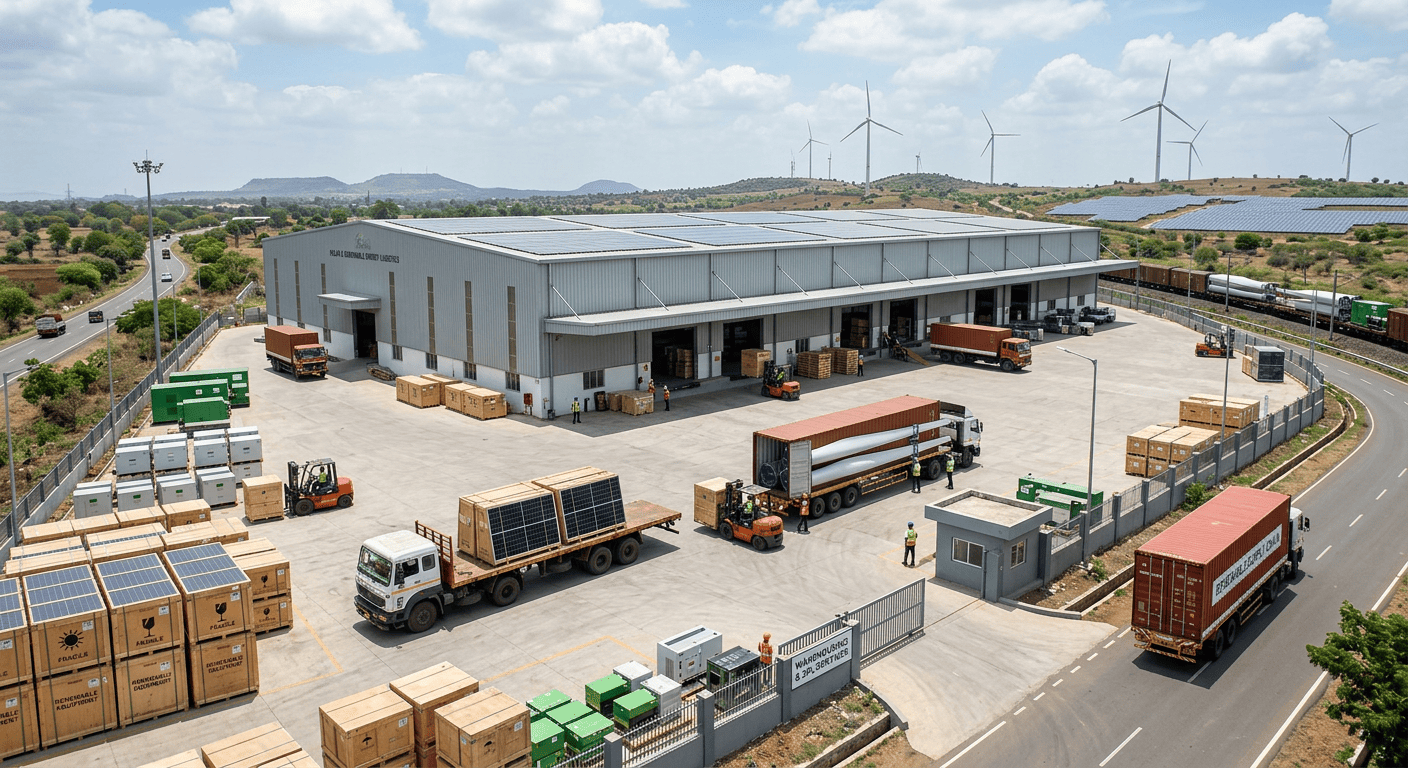
Goldfishh brings together warehousing, warehouse management, transportation and import/export logistics so that Solar & Renewable Energy Equipment companies can work with one integrated supply-chain partner.
01. LOGISTICS & WAREHOUSING
Multiple solar equipment clients share space inside a specialized warehouse facility. Products are stored in dedicated zones with barcode and serial number tracking. Best for inverter distributors, mounting structure suppliers, and importers requiring flexible storage.
SHARED CAPACITY
Pay-per-pallet rate with SKU-level tracking. Scalable pay-per-use capacity for project-based demand.
02. LOGISTICS & WAREHOUSING
An entire facility or independent building block secured exclusively for a single enterprise, engineered to bespoke module racking, open-yard storage, and secure equipment zones. Best for solar OEMs, large EPC contractors, and BESS distributors.
EXCLUSIVE OPERATIONS
Fixed long-term lease or built-to-suit (BTS) facilities customized for your solar equipment operations across India.
03. LOGISTICS & WAREHOUSING
Goldfishh deploys trained solar equipment handling personnel, safety supervisors, and WMS software to manage project site storage and staged dispatch for EPC contractors in India. Best for utility-scale solar projects requiring on-site material management.
PROJECT OPERATIONS
Deployed material management staff & WMS at project sites. Managed throughput SLA / operational fee.
04. LOGISTICS & WAREHOUSING
Rapid warehouse and open-yard sourcing matching specific size, floor load bearing, clear height, module racking, and highway proximity requirements for solar equipment distribution.
WAREHOUSE & YARD SOURCING
Flexible commercial lease terms tailored to project cycles and solar industry seasonality.
05. LOGISTICS & WAREHOUSING
Dedicated vertical and near-vertical racking systems with cushioned supports for solar modules, preventing micro-cracks and breakage during storage and handling.
MODULE PROTECTION
Vertical racking with cushioned support, reducing breakage and micro-crack risks for solar modules.
06. LOGISTICS & WAREHOUSING
Inter-state solar equipment shipping with project cargo documentation. Vehicles equipped for safe movement of oversized modules, structures, and heavy transformers to project sites.
PROJECT CARGO
GPS-tracked movement with project cargo documentation, dedicated transit insurance, and delivery confirmation.
| Engineering Specification | Structural Feature | Safety & Operational Purpose |
|---|---|---|
| Vertical Module Racking | Near-vertical racks with cushioned supports | Prevents glass module breakage and micro-cracks during storage |
| Open-Yard Storage Areas | Paved, drained outdoor storage yards | Accommodates oversized mounting structures and transformers |
| High-Clearance Indoor Bays | Tall clear-height warehouse sections | Stores large inverters, BESS containers, and project cargo |
| Access-Controlled Secure Zones | CCTV, biometric access, and alarm systems | Protects high-value inverters and BESS units from theft |
| Fire Suppression for BESS | Water mist or inert gas systems in battery bays | Specialized suppression for lithium battery energy storage systems |
| Dust & Moisture Control | Sealed flooring and humidity monitoring | Protects electrical components and inverters from environmental damage |
| Operational Protocol | Standard Operating Procedure (SOP) | Business Objective |
|---|---|---|
| 1. Inbound Module Inspection | Check for glass cracks, frame damage, and junction box integrity | Prevents damaged modules from entering sellable project inventory |
| 2. Vertical Racking Put-Away | Store modules vertically with cushioned supports and proper spacing | Prevents micro-cracks and breakage during storage |
| 3. Serial Number Tracking | Record module and inverter serial numbers at inbound and outbound | Enables warranty claims, traceability, and project documentation |
| 4. Project Staging & Kitting | Assemble complete project kits for staged site dispatch | Ensures project sites receive complete, ready-to-install material sets |
| 5. Damage-Free Dispatch | Use shock-absorbing packaging and proper loading for modules | Ensures solar modules reach project sites without transit damage |
A single integrated partner delivering nationwide scale, operational rigor, and module-safe storage confidence for solar and renewable energy supply chains.
150+ audited warehouses across 35+ industrial cities representing over 2 million sq. ft. of active capacity.
Specialized solar facility infrastructure with vertical module racking, cushioned supports, open yards, and secure equipment zones.
Coordinated factory-to-warehouse and port-to-project-site movement via dedicated FTL and project cargo networks.
Rapid transitions between shared multi-client space, dedicated solar leases, open yards, and managed 3PL operations.
Certified staff trained in fragile module handling, heavy equipment movement, and serial number tracking protocols.
Cloud-based WMS providing real-time serial number tracking, project kitting, barcode scanning, and dispatch audit readiness.
Clear answers to critical questions about Solar & Renewable Energy Equipment warehousing, logistics, and operations in India.
Solar equipment storage requires specialized facilities with vertical module racking for fragile panels, open-yard storage for oversized mounting structures, high-clearance indoor bays for inverters and BESS, secure access-controlled zones for high-value equipment, and fire-rated battery storage areas for energy storage systems.
Goldfishh uses vertical and near-vertical racking systems with cushioned supports for solar modules, preventing glass breakage and micro-cracks that can degrade panel performance. Inbound inspection checks for existing damage, and trained handlers follow strict protocols for module movement and stacking.
Yes. Goldfishh stores BESS units in isolated, fire-rated bays with continuous thermal monitoring, specialized fire suppression systems (water mist or inert gas), State of Charge management, and strict separation from combustible materials in compliance with UN Class 9 hazardous goods regulations.
A compliant solar equipment warehouse must feature vertical module racking with cushioned supports, open-yard storage for oversized components, high-clearance indoor bays, access-controlled secure zones, CCTV surveillance, fire suppression for BESS, and dust/moisture control for inverters and electrical components.
Yes. Goldfishh offers on-site 3PL project warehouse management, deploying trained solar equipment handling staff, safety supervisors, and WMS technology directly at project sites for EPC contractors executing utility-scale solar installations.
Clients must provide product SKU details, module serial numbers for warranty tracking, BIS and ALMM certification where applicable, MSDS for BESS units, and handling instructions for fragile modules and oversized components.
Yes. Goldfishh provides paved, drained open-yard storage areas for oversized solar components including mounting structures, steel piles, transformers, and large project cargo that cannot be stored indoors.
Pricing is structured based on storage footprint (pallet, module count, or open-yard area), storage type (standard, vertical module racking, open yard, BESS-safe), specialized handling needs (project kitting, serial tracking), and contract duration. Contact Goldfishh for a tailored commercial proposal.