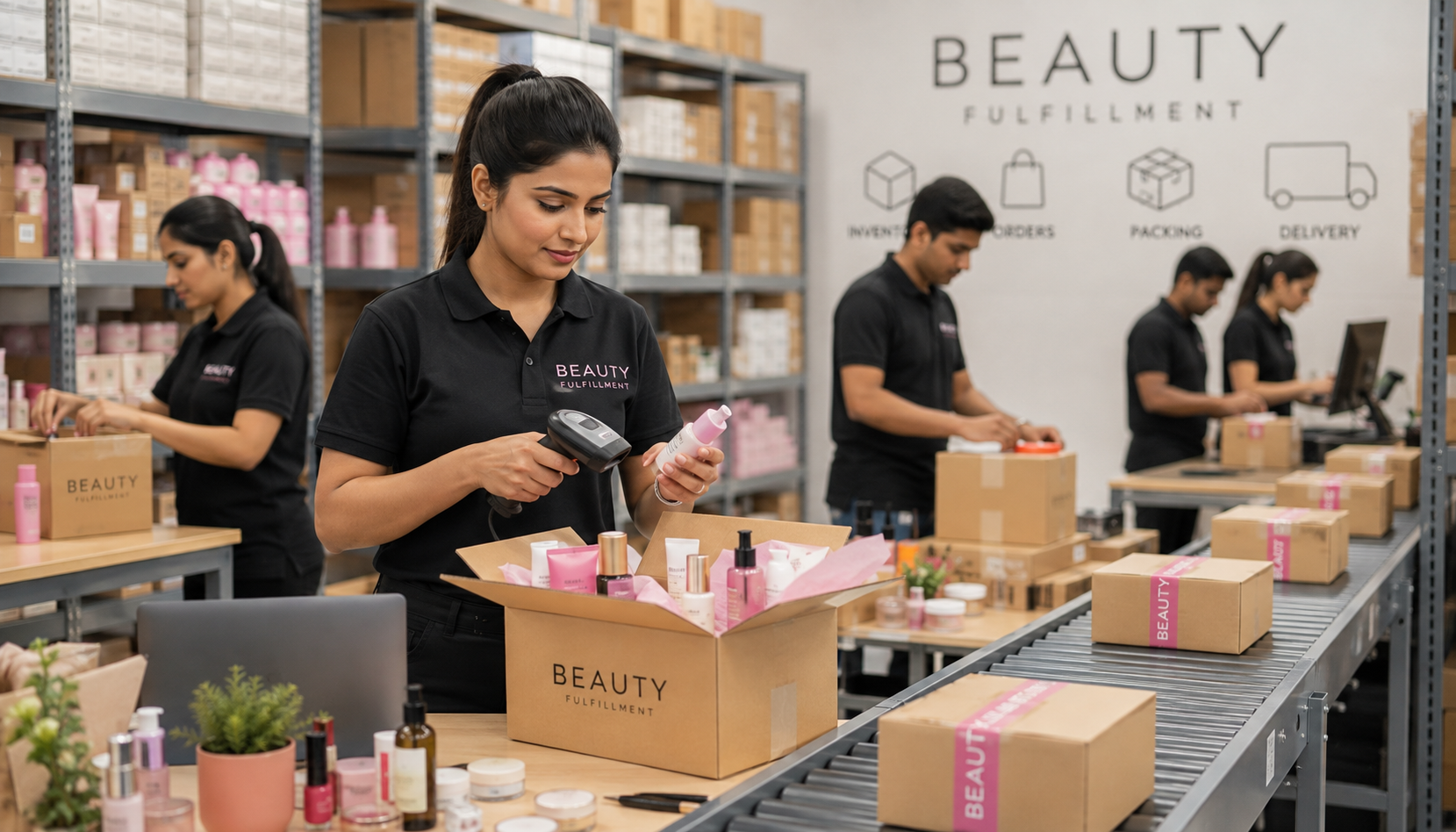
What Is Beauty Fulfillment?
Beauty fulfillment is the process of managing, storing, preparing, packing, and delivering cosmetics and personal care products after an order is placed.
For an online beauty brand, fulfillment goes beyond simply shipping an order. It involves keeping the right products in stock, managing multiple SKUs, picking the correct items, creating kits or bundles when required, packaging products safely, dispatching orders on time, and handling returns.
Cosmetics and personal care brands can have particularly complex fulfillment requirements because their catalogs often contain many small products, variants, bundles, promotional samples, liquids, glass containers, and products with specific storage or transportation considerations.
A well-designed beauty fulfillment process helps brands improve order accuracy, control inventory costs, deliver products faster, and create a better post-purchase experience.
How Does Beauty Fulfillment Work?
A typical beauty fulfillment workflow can be divided into several connected stages:
| Stage | What Happens |
| Inventory receiving | Products arrive at the warehouse and are checked and recorded |
| Storage | SKUs are organized for efficient storage and retrieval |
| Order processing | Customer orders are received through ecommerce or marketplace channels |
| Picking | The required products are picked from inventory |
| Kitting | Multiple products may be combined into bundles or promotional sets |
| Packing | Products are packed according to brand and shipping requirements |
| Labelling | Shipping and product labels are applied |
| Dispatch | Orders are handed over to logistics partners |
| Tracking | Customers receive order and delivery updates |
| Returns | Returned products are received, inspected, and processed |
The efficiency of the entire process depends on how well these stages work together.
A problem with inventory accuracy, for example, can result in incorrect picking. Poor packing can cause product damage. Delayed dispatch can affect customer satisfaction and marketplace performance.
1. Inventory Management for Beauty Brands
Inventory management is one of the most important parts of beauty fulfillment.
Beauty brands can quickly accumulate a large number of SKUs across categories such as skincare, haircare, makeup, fragrances, personal hygiene, and accessories. Each product may also have different sizes, variants, shades, packs, or bundles.
Poor inventory management can result in:
- Overstocking slow-moving products
- Stockouts of popular products
- Excess warehouse space requirements
- Higher inventory holding costs
- Difficulty locating products
- Incorrect orders
- Delayed fulfillment
A good beauty warehouse should therefore make products easy to identify, store, count, and retrieve.
Small cosmetics products particularly benefit from organized shelving and clearly defined SKU locations. Fast-moving products can also be positioned closer to picking and packing areas to reduce unnecessary movement.
Inventory Practices That Help
| Practice | Benefit |
| SKU-level tracking | Improves inventory visibility |
| Organized shelving | Makes picking faster |
| Stock movement analysis | Identifies slow and fast movers |
| Regular inventory reconciliation | Reduces inventory discrepancies |
| Demand forecasting | Helps plan replenishment |
| Multi-location inventory visibility | Supports distributed fulfillment |
For growing brands, connecting inventory management with order processing can make it easier to understand available stock across sales channels.
2. Kitting and Bundling in Beauty Fulfillment
Kitting is particularly useful for cosmetics and personal care brands.
A kit combines multiple products into a single sellable unit. For example, a skincare brand could sell:
- Cleanser + moisturizer
- Face serum + sunscreen
- Shampoo + conditioner
- Haircare routine kits
- Makeup starter kits
- Festive beauty gift sets
- Subscription boxes
Instead of picking each component separately for every order, brands can prepare certain kits in advance.
This can improve fulfillment efficiency and order accuracy while making promotional campaigns easier to execute.
Kitting is also useful when brands offer promotions such as:
Buy one product and receive a free sample.
The warehouse team needs to know exactly which products belong in the promotional order. A properly defined kitting workflow can reduce errors and ensure promotional items are included consistently.
3. Packing Cosmetics and Personal Care Products
Packaging plays two roles in beauty fulfillment: product protection and customer experience.
Cosmetics can include bottles, jars, tubes, palettes, glass containers, pumps, and other packaging formats. Some products may require additional protection during transportation.
At the same time, beauty customers often pay attention to the unboxing experience.
Depending on the brand, packaging may include:
- Protective inserts
- Tissue paper
- Branded boxes
- Samples
- Promotional cards
- Gift wrapping
- Stickers
- Personalized messages
However, every packaging addition increases material and labor costs.
Brands should therefore balance presentation with fulfillment economics. The objective is not simply to create elaborate packaging but to develop a repeatable packing process that protects the product while maintaining the desired brand experience.
4. Shipping and Delivery for Beauty Products
Shipping is another major part of beauty fulfillment.
Customers increasingly expect fast and predictable delivery. For brands selling across India, the distance between the fulfillment location and customer can affect transportation cost and delivery time.
A brand operating from one warehouse may be able to fulfill orders effectively at an early stage. As order volume increases, however, distributed fulfillment may become useful.
For example:
| Fulfillment Approach | Suitable For |
| Single warehouse | Smaller or geographically concentrated demand |
| Regional warehouses | Brands with demand across multiple regions |
| Distributed fulfillment | High-volume brands serving customers nationwide |
| Marketplace fulfillment network | Brands heavily dependent on marketplaces |
| Hybrid model | Brands selling across marketplaces, Q-commerce, and their own website |
The right model depends on order volume, customer locations, inventory profile, service expectations, and cost structure.
5. Safety and Compliance in Cosmetics Fulfillment

Not every beauty product can be handled and shipped in exactly the same way.
Products containing liquids, chemicals, alcohol-based formulations, aerosols, or other regulated components may have specific packaging, labelling, storage, or transportation requirements depending on the product and destination.
For example, products such as nail polish, fragrances, aerosols, or certain chemical-based personal care products may require additional attention during transportation.
Beauty brands should identify any product-specific requirements before creating their fulfillment workflow.
Warehouse and logistics teams should also understand:
- Product handling requirements
- Packaging specifications
- Labelling requirements
- Carrier restrictions
- Storage conditions
- Applicable transportation regulations
For products with specialized requirements, brands should work with fulfillment and logistics providers that understand the relevant handling processes rather than treating every SKU identically.
6. Order Accuracy and Customer Experience
Beauty fulfillment directly affects the customer experience.
A customer may have a positive experience on a brand’s website but still become dissatisfied if:
- The wrong product arrives
- A shade or variant is incorrect
- A promotional sample is missing
- The package arrives damaged
- Delivery is delayed
- Return communication is unclear
Order accuracy therefore needs to be measured throughout the fulfillment process.
A strong fulfillment workflow should provide visibility from the moment an order is received through picking, packing, dispatch, delivery, and returns.
Order status updates are also important. Keeping customers informed can reduce uncertainty and improve the overall post-purchase experience.
7. Returns and Reverse Logistics
Returns are another important component of beauty fulfillment.
Beauty products can present unique challenges because returned products may need to be inspected before being returned to sellable inventory.
Depending on the product and its condition, the warehouse may need to determine whether it can be:
- Returned to inventory
- Sent for quality inspection
- Disposed of
- Returned to the manufacturer
- Processed under a specific returns workflow
A clear returns process helps brands maintain inventory accuracy and customer communication.
The return policy should also be easy for customers to understand. Ambiguous policies can create friction and may discourage future purchases.
8. Freight Efficiency for Beauty Brands
Fulfillment costs are not limited to warehouse operations. Transportation and freight can have a significant effect on overall logistics costs.
Beauty brands may need to move products through several stages:
Manufacturer → Fulfillment warehouse → Marketplace/Q-commerce hub → Customer
Brands selling through multiple channels may also need to replenish different warehouses or marketplace locations.
Better freight planning can help brands manage these movements more efficiently.
Some strategies include:
- Consolidating shipments where practical
- Planning replenishment ahead of demand
- Using regional inventory strategically
- Comparing carrier costs
- Optimizing shipment sizes
- Separating B2B and B2C fulfillment workflows when required
The objective is to reduce unnecessary movement without compromising product availability or delivery performance.
Beauty Fulfillment for Omnichannel Brands
Modern beauty brands rarely depend on only one sales channel.
A growing brand may sell through:
- Its own ecommerce website
- Amazon
- Flipkart
- Myntra
- Meesho
- Q-commerce platforms
- Physical retail
- Distributors
- B2B or modern trade channels
Each channel can have different order, inventory, packaging, dispatch, and delivery requirements.
This makes centralized visibility increasingly important.
Instead of managing every channel independently, brands can build fulfillment operations that connect inventory, orders, warehouse operations, and distribution.
This is particularly important during product launches, promotional campaigns, festive periods, and high-demand events when order volumes can increase rapidly.
How Technology Improves Beauty Fulfillment
Technology can connect the different stages of the fulfillment process.
A technology-enabled fulfillment setup can help brands manage:
| Area | Role of Technology |
| Inventory | Track available stock and movements |
| Orders | Capture and process orders across channels |
| Warehouse | Support picking, packing, and dispatch workflows |
| Returns | Track returned orders and their status |
| Customer service | Provide order lifecycle visibility |
| Reporting | Monitor fulfillment and operational performance |
Order Management Systems (OMS) and Warehouse Management Systems (WMS) can be particularly useful for brands managing multiple sales channels or fulfillment locations.
The objective is not simply to add technology but to create better visibility and coordination across the fulfillment operation.
When Should a Beauty Brand Consider Outsourced Fulfillment?
Outsourcing fulfillment can become relevant when warehouse operations start taking significant time and resources away from growth activities.
A beauty brand may consider a fulfillment partner when:
- Order volumes are increasing rapidly
- SKU counts are becoming difficult to manage
- Multiple marketplaces are being added
- Q-commerce expansion requires additional fulfillment locations
- Warehouse space is becoming difficult to manage
- Picking and packing requires a dedicated team
- Returns are becoming operationally complex
- Customers expect faster delivery
- The brand wants to expand into new geographic markets
The decision should be based on total operational requirements rather than warehouse cost alone.
Goldfishh EMBRACE for Beauty and Personal Care Brands
For beauty and personal care brands looking beyond basic warehousing, fulfillment can become part of a broader ecommerce growth strategy.
Goldfishh EMBRACE is designed for brands scaling across e-commerce, Q-commerce, their own websites, and B2B channels. Its offering combines marketplace growth with technology-enabled fulfillment and a pan-India warehouse network.
For brands selling through marketplaces, EMBRACE supports fulfillment operations across channels such as Amazon and Flipkart, while its Q-commerce capabilities support platforms including Blinkit, Zepto, and Swiggy Instamart.
Its warehouse fulfillment operations include OMS-driven order capture, inventory management and GRN processing, picking, packing, labelling, dispatch, returns, customer service workflows, and CRM/order lifecycle visibility.
This makes EMBRACE relevant for D2C beauty brands that want to expand digital distribution without building every marketplace, fulfillment, and operational capability internally.
It can also support manufacturers entering marketplaces, offline brands transitioning to omnichannel retail, growth-stage brands expanding into Q-commerce, and international brands entering India.
The broader idea is simple: as a beauty brand grows, fulfillment needs to scale alongside its sales channels. A connected model can help brands manage distribution and fulfillment while focusing more of their internal resources on product, marketing, and growth.
FAQs About Beauty Fulfillment
What is beauty fulfillment?
Beauty fulfillment is the process of storing, managing, picking, packing, shipping, and processing returns for cosmetics and personal care products ordered through ecommerce, marketplaces, Q-commerce, or other sales channels.
Why is fulfillment important for beauty brands?
Fulfillment affects inventory accuracy, order processing speed, product protection, delivery performance, returns, and the overall customer experience. Efficient fulfillment can help growing beauty brands handle higher order volumes more consistently.
What products can beauty fulfillment cover?
Beauty fulfillment can cover products such as skincare, haircare, makeup, fragrances, personal hygiene products, beauty accessories, gift sets, bundles, and other personal care products, subject to applicable handling and transportation requirements.
What is kitting in beauty fulfillment?
Kitting involves combining multiple products into a predefined bundle or kit. Examples include skincare routines, haircare sets, gift boxes, and promotional product combinations.
How can beauty brands reduce fulfillment costs?
Brands can improve fulfillment economics by optimizing inventory levels, organizing warehouse storage, improving picking efficiency, planning replenishment, selecting appropriate packaging, consolidating freight where practical, and using strategically located fulfillment facilities.
Should beauty brands outsource fulfillment?
Outsourcing can make sense when order volumes, SKU counts, sales channels, geographic coverage, or operational complexity become difficult to manage internally. The right decision depends on the brand’s specific fulfillment requirements and growth plans.
What is the difference between beauty fulfillment and beauty warehousing?
Beauty warehousing primarily focuses on storing and managing inventory. Beauty fulfillment covers the broader process from receiving and storing products to picking, packing, dispatch, delivery coordination, and returns.
Can beauty fulfillment support multiple sales channels?
Yes. A fulfillment operation can be designed to support orders from a brand’s own website, marketplaces, Q-commerce platforms, and B2B channels. The exact workflow depends on the channels and their operational requirements.
Conclusion
Beauty fulfillment is more than simply moving cosmetics from a warehouse to a customer.
For growing beauty and personal care brands, fulfillment connects inventory management, warehousing, kitting, packing, shipping, returns, customer communication, and freight planning.
As brands expand across marketplaces, Q-commerce, their own websites, and B2B channels, these processes become increasingly interconnected. A fulfillment model that provides better inventory visibility, accurate order processing, efficient warehouse operations, and scalable distribution can help brands manage growth more effectively.
For brands that need more than standalone warehousing, Goldfishh EMBRACE combines ecommerce and Q-commerce growth capabilities with integrated fulfillment operations, giving growing brands an option to build a more connected approach to digital distribution and order fulfillment.